

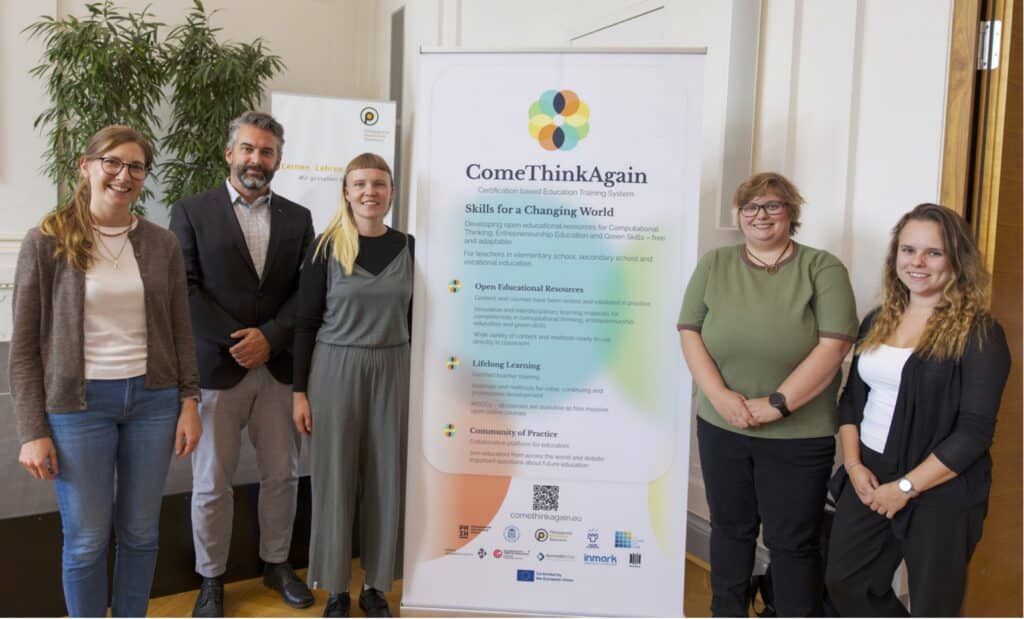
On 24 September 2026, ComeThinkAgain took the stage at Digital Education Day at Pädagogische Hochschule Steiermark with a question that does not have a comfortable answer: are we actually preparing educators — and through them, learners — for the world that is emerging? Or are we equipping them for a version of the future that is already out of date?
The honest answer, in most cases, is the latter.
Tools do not teach. Educators do
The dominant response to digital transformation in education has been to add technology. More devices. Better platforms. Faster connectivity. But as Maria Grandl argued in her opening remarks, the gap between the technology available in a classroom and the competence of the educator using it — that is where most digital education strategies quietly fail.
Teachers and VET trainers are being asked to integrate computational thinking, entrepreneurship, and sustainability into their practice with little or no formal training in any of these areas. The expectation has shifted faster than the preparation has.
The smarter question
Grandl drew on psychologist Gerd Gigerenzer to reframe the challenge: the smarter machines become, the smarter people need to become. Not smarter in the same ways as machines — faster, more efficient, better at processing data — but smarter in the ways machines cannot replicate. Critical judgment. Ethical reasoning. The ability to act responsibly under uncertainty.
This means digital education is not primarily about teaching people to use technology. It is about developing the human capacities that technology cannot replace. An educator who teaches a student to decompose a complex problem rather than just search for an answer. One who cultivates the belief that problems are solvable and that agency matters. One who brings sustainability into a lesson not as an add-on but as a lens.
These are not peripheral skills. They are the core competencies of a generation inheriting a world shaped by AI, climate change, and rapid economic transformation.
Why three competencies together matter more than three apart
Grandl also introduced the concept of wicked problems — challenges so complex and so entangled with other challenges that no single discipline can resolve them. Climate change is a wicked problem. So is digital transformation. The solutions that work bring disciplines into conversation rather than isolating them.
This is the logic Harald Burgsteiner used to explain ComeThinkAgain’s design. Computational Thinking, Entrepreneurial Thinking, and Green Skills are not three separate priorities. The most impactful work happens at their intersections — what the project calls the “sweet spots” — where a learner applies analytical thinking to a sustainability challenge and uses entrepreneurial reasoning to design a response.
What the evidence shows
Sandra Tomaschek presented results from the first pilot cycle — 79 participants across primary, secondary, and vocational education. Educators consistently valued the practical orientation of the modules and the peer exchange. The most cited strength: learning alongside colleagues working through the same challenges in their own contexts.
Critical feedback pointed to content volume and the need for more contextual adaptation — exactly the kind of signal that makes a second cycle better than a first. That second cycle begins in autumn 2026, with six interdisciplinary modules.
The attitude that makes the difference
Perhaps the most resonant idea from the keynote was what Grandl called critical confidence — looking honestly at technological change, acknowledging its uncertainties, and still believing the situation is modifiable. Not techno-optimism. Not techno-pessimism. The capacity to act thoughtfully in conditions of genuine uncertainty.
This is what ComeThinkAgain is building — in educators, and through educators, in learners. When an educator develops this attitude in their own relationship to digital change, they become capable of cultivating it in the students they teach.
The river of technological change will not stop. The question is whether we are teaching people to navigate it.
Watch the full keynote The presentation was delivered at Digital Education Day, PH Steiermark, on 24 September 2026.
Watch on YouTube (Originally presented in German — subtitles available in multiple languages)